
By Thomas Charlton, Goliath Technologies
When clinicians experience performance issues with Oracle Health EHR, often the immediate assumption is that the problem lies with the application vendor. Many believe there is a direct, one-to-one connection between the end user and the data center where the application is hosted.
Goliath offers great observability by giving us objective measurement of clinician satisfaction with Millennium and the analytics to foster a productive, data-driven dialogue between our IT staff and Oracle to resolve issues.
Jamey Pennington, CIO, Southwell Health
The perception: Oracle Health EHR is the root cause of performance issues
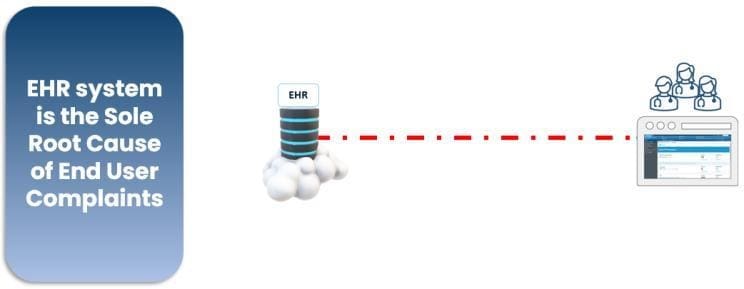
Not so fast!
The reality: a complex IT ecosystem
In truth, performance issues are rarely that straightforward. As illustrated below, there are multiple IT infrastructure elements, applications, and other variables between the clinician and the EHR application.
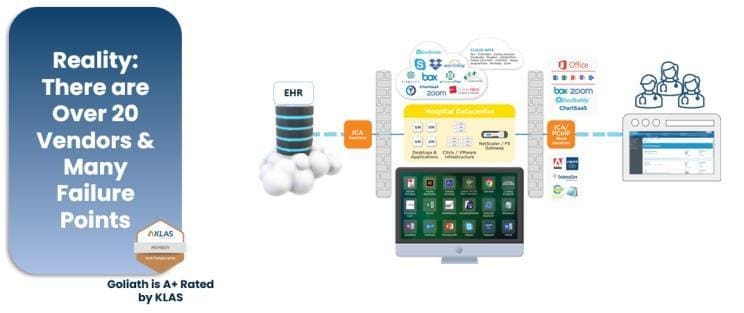
Over the last decade, we’ve participated in numerous Incident Response Calls (IRCs) and troubleshooting sessions with Oracle Health EHR clients. From these experiences, three key takeaways stand out:
- Most speed and reliability issues attributed to Oracle Health EHR originate on the client side.
- Clients lack the necessary data to identify and isolate these client-side issues.
- With the right data, clients can resolve issues faster, without escalating to Oracle.
Why Oracle’s hosting isn’t usually the issue
Oracle Health EHR operates in a highly controlled, well-managed hosting environment with robust performance monitoring. It has been our experience, when attempting to resolve speed and reliability issues, that the client doesn’t have the same visibility into their IT infrastructure and end users as Oracle does, so there isn’t a common set of facts upon which to build a resolution plan. Oracle has very complete performance data, while the client has limited insight into the IT elements and many variables that can impact clinician experience. This incomplete picture on the client side results in many hours of wasted time attempting to isolate the root cause of issues.
Having the right data matters
In an Oracle Health hosted environment, accurately isolating the root cause of clinician experience issues requires access to the right operational and experiential data, not assumptions or self-reported feedback. Because Oracle hosts and manages the core infrastructure, most traditional IT monitoring tools lack visibility into what clinicians actually experience at the point of care. Through Goliath’s exclusive access to Oracle-approved clinician experience and performance telemetry, healthcare organizations gain objective, real-time insight into session performance, application responsiveness, and end-user experience. This unique data foundation enables IT and clinical leadership to quickly differentiate between EHR application issues, network latency, virtualization performance, and endpoint constraints, dramatically reducing troubleshooting time and allowing teams to focus remediation efforts where they will have the greatest clinical impact.
Here is an example from an actual health system we worked with recently on a project to improve speed and reliability.
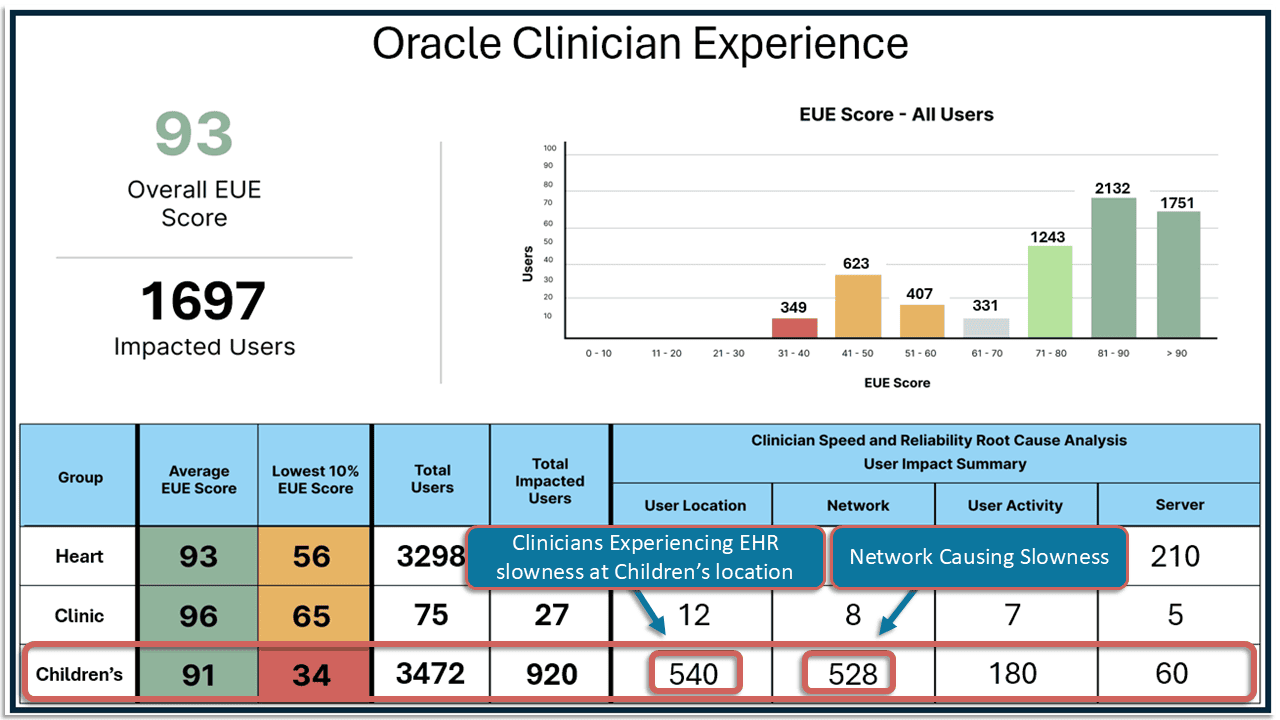
Troubleshooting any hosted application is complex, but without the right performance data, it becomes nearly impossible. This is where end-user experience analytics make a difference.
While we don’t claim that Goliath Technologies is the answer to every issue, we do provide a unique level of visibility that Oracle Health EHR clients simply don’t have elsewhere. With our technology, you can:
- See exactly which clinicians are experiencing performance issues.
- Identify issue frequency, duration, and likely root cause.
- Eliminate guesswork and reduce reliance on clinician self-reporting.
If you would like to discuss further, reach out to techinfo@goliathtechnologies.com or request to speak with a healthcare IT consultant.